


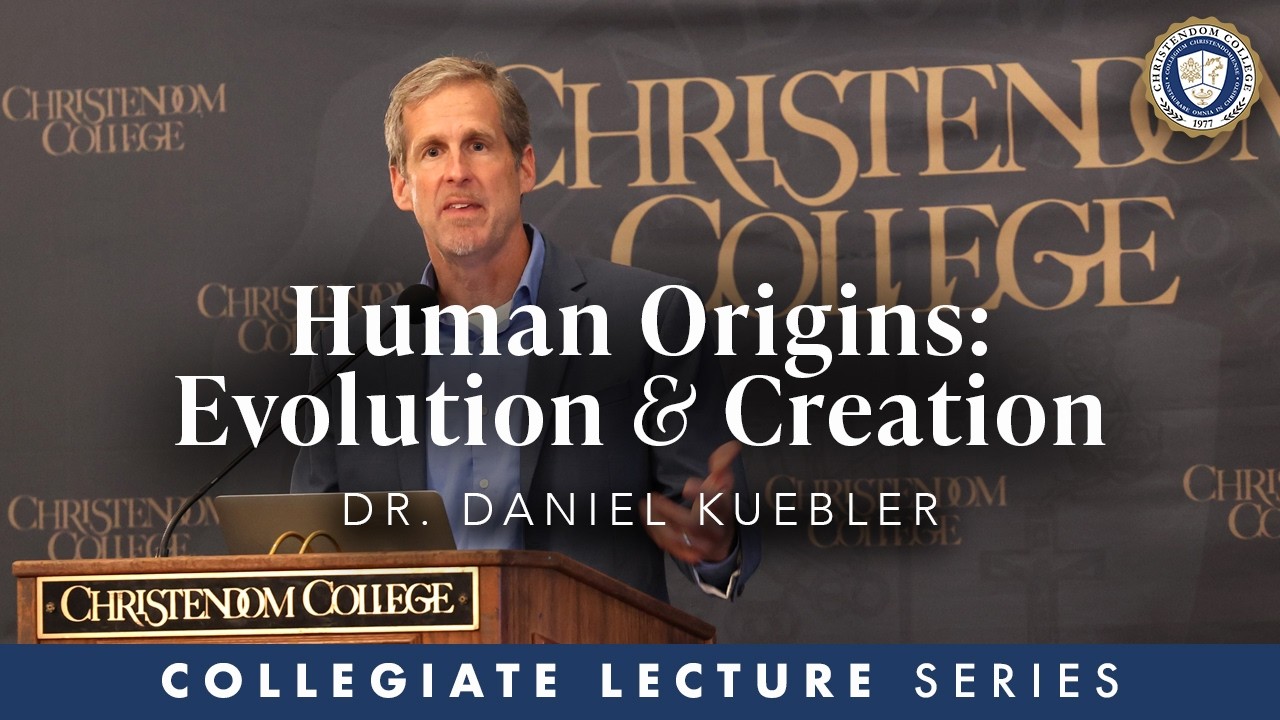
Christendom College welcomed biologist and author Dr. Daniel Kuebler to campus for the college’s first Collegiate Lecture Series event of the academic year on September 21. In a talk titled “Human Origins: Evolution and Creation,” Kuebler presented possible ways of properly understanding human origins that are consistent with both Catholic teaching and the science of evolution.
Kuebler, a Professor of Biology at Franciscan University and host of the Purposeful Lab podcast, began his lecture by emphasizing the omnipotence of God over creation and the evolutionary process, and the inability of modern science to explain man’s spiritual nature.
He followed this with an outline of his talk’s four parts: an overview of Church teaching on creation and human evolution, hominin evolution, a history of the fossil record, and speculation about the emergence of modern humans.
Kuebler was quick to warn against theories of evolution that contradicted Church teaching.
“Any theory of evolution that tries to explain away the soul, or to explain that the soul evolved, or to scientifically dismiss that is something that goes beyond science and is something that the Church would condemn,” he said.
Elaborating on Pope Benedict XVI’s writings about the relation of the Genesis account of creation to man’s biological origin, Kuebler said, “The creation account is trying to understand the nature of the human person….whereas a biologist or an evolutionary biologist would be trying to understand how the physical form may have come into existence.”
Next, he outlined the current fossil record and explained a timeline of early human development, pointing out that it does not follow a neatly ordered progression, but appears as a mosaic of characteristics. He also explained several of the oldest human fossils found and which one was most likely to be the first modern human.
Kuebler also noted that factors like migration and the development of brain and facial structure create inconsistency in fossil records, as well as difficulty in determining whether fossil skulls are actually human.

“To be human, to be made in the image and likeness of God, to be the type of thing that’s fitting to have a rational soul—how do you identify that in the fossil record?” questioned Kuebler.
The biologist highlighted advancements like composite tool use, ritualistic findings, and artwork as examples of when scientists can trace modern human development as rational beings.
“It doesn’t mean that rational, conceptual thought didn’t exist before this time, but I think you have very good evidence for this at least 100,000 years ago and then extremely good evidence for it 50,000 years ago, and this is widespread throughout the globe,” Kuebler explained.
“And that would suggest that theological humans, humans that have rational, conceptual thought, would have emerged in Africa in the last 150,000 to 250,000 years ago, depending on your interpretation of some of the archaeological evidence for rational and conceptual thought.”
Kuebler concluded the talk with his own speculations about the origins of the first humans, laying out three possible answers. He briefly delved into why the first solution, which treats the Genesis creation account as historically and biologically accurate, and the second solution, which requires the infusion of a soul into an evolved human body, seem implausible, then explained a third possibility compatible with both Catholicism and evolutionary biology.
“So if we think about the origins of modern humans, I think the best way to think about it is in relation to Christ,” said Kuebler.
“Christ comes in and makes Himself dependent upon creation, just as modern humans would’ve been dependent upon the best of creation as we come into existence as a species.”
The evening finished with a Q&A session, in which students, faculty, staff, and members of the local community asked questions regarding Kuebler’s talk.

This lecture joins Christendom’s past Collegiate Lecture Series events, including talks from acclaimed poet Dr. James Matthew Wilson and author and professor Dr. Clint Brand, each of whom offered an evening of dynamic engagement with perennial truths—the very purpose of each Collegiate Lecture Series event.
Christendom’s Collegiate Lecture Series provides students, faculty, staff, and members of the community with an opportunity to hear from regional and national speakers on topics relevant to Christendom’s mission of “Restoring All Things in Christ.” For students, especially, these events allow them to connect classroom learning with the broader ideas and questions posed by the speakers. The series also honors those who have pursued wisdom in their lives and share it generously with the Christendom community.
Additional Collegiate Lecture Series events are planned throughout the academic year, including a lecture from Notre Dame’s Dr. Mary Keys on St. Augustine’s political thought on October 5.
Watch the full lecture below:
Contributed by Bridget Palm ’28.