


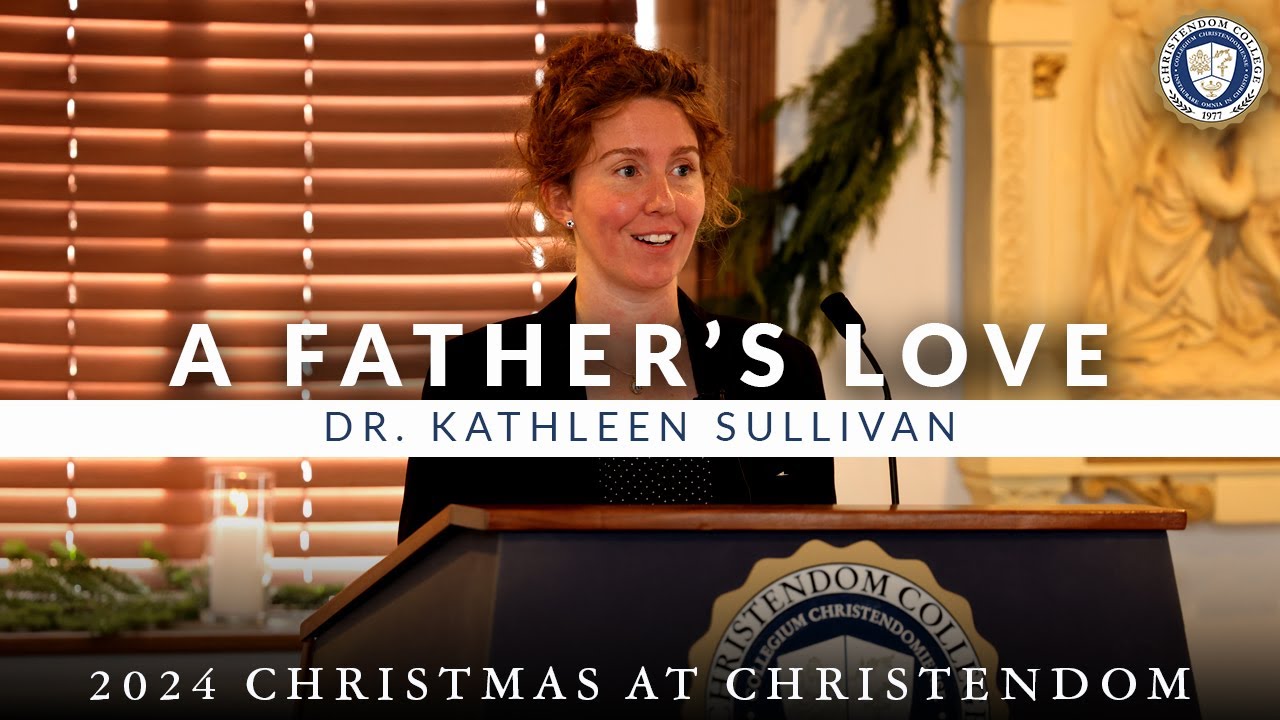
In Lucy Maud Montgomery’s Anne of Green Gables, Montgomery presents the character of Matthew Cuthbert — a shy, old farmer. How does his fatherly love emulate the love of Christ? Christendom English Language and Literature Professor Dr. Kathleen Sullivan explains in this latest piece for Instaurare Magazine.
A lady shopkeeper is not as menacing as a hungry lion in his den, but Matthew Cuthbert would rather face the lion. Shy, sixty-year-old farmer Matthew is a quiet character in Lucy Maud Montgomery’s book Anne of Green Gables, but like the quiet carpenter St. Joseph, Matthew’s presence makes a powerful impact on those around him. To the friendless orphan girl Anne Shirley he offers protection, to her love-starved heart he provides a haven of peace, and to her wildly imaginative fancies, he offers a steadfast foundation, guiding her to choose the good. A man of few words, Matthew’s patient love for Anne reveals a father who is humble in offering his strength to protect her, tender in showing his desire to provide for her, and gentle in his guidance when correcting her wrongs. In so doing, Matthew’s fatherly love reveals our Heavenly Father’s own love in protecting us, providing for us, and being eternally patient with us as we strive for holiness.
The story begins with Matthew and his sister Marilla having decided, one Christmas, to adopt a young boy to help Matthew on their Prince Edward Island farm; yet a miscommunication led to a meeting that would change their lives forever. Arriving at the train station to pick up the boy, Matthew discovers that the orphanage sent a girl instead. Painfully shy Matthew seeks protection from doing “that which was harder for him than bearding a lion in its den—walk up to a girl—a strange girl—an orphan girl—and demand of her why she wasn’t a boy.” Yet as soon as they meet, Matthew forgets about himself in recognizing that she is the one in need of protection. The red-haired eleven-year-old brightly tells him: “I suppose you are Mr. Matthew Cuthbert of Green Gables? … I had made up my mind that if you didn’t come for me to-night I’d go down the track to that big wild cherry-tree at the bend, and climb up into it to stay all night. I wouldn’t be a bit afraid, and it would be lovely to sleep in a wild cherry-tree all white with bloom in the moonshine, don’t you think?” (11-12). Even though she seems quite eager to spend the night in a cherry tree, Matthew knows he cannot leave her alone and abandoned. Matthew’s response is one of fatherly protection: he offers to carry her bag and leads her to the carriage to take her home. Despite knowing of Marilla’s disapproval and despite the fear of sharing a carriage ride with a strange girl, Matthew sets aside his own desires to act for the good of hers.
This story comes from the latest issue of Instaurare Magazine, the official magazine of Christendom College. Read more from Instaurare here!
On the carriage ride, he accepts and validates her just as she is. Anne’s questions stream forth in a dizzying fashion: Does the blossoming cherry tree make Mr. Cuthbert think of “a bride all in white with a lovely misty veil?” (13); “what does make the roads red?” (14); has he “ever imagined what it would be like to be divinely beautiful?” (17). Would he rather be “divinely beautiful, dazzlingly clever, or angelically good?” (17). Although Matthew “felt as he had once felt in his rash youth when another boy had enticed him on the merry-go-round at a picnic” (17), he marvels at Anne’s imagination and does not stop her exuberance; instead, Matthew offers her a quiet and protective shelter of paternal attention on the carriage ride to Green Gables.
Shuffled among foster homes and orphanages for ten years, Anne had endured the abuse of neglect, intoxicated adults, and indifference. Treated as less than a servant in these places, Anne believes that she is only loveable if she is useful or beautiful; she is also wary of exhausting others with her talk. Yet Matthew offers Anne a protective haven when he replies to her anxiety: “Oh, you can talk as much as you like. I don’t mind” (16). His fatherly care for her on the carriage ride continues when he faces Marilla’s displeasure. His stern sister insists that they return Anne to the orphanage since she would be of no good to them. Yet Matthew “unexpectedly” and boldly claims, “We might be some good to her” (29). Matthew’s newly-awakened fatherly love protects Anne not only from the physical danger of neglectful orphanages and sleeping in cherry trees, but more essentially, from the spiritual danger of finding herself abandoned as an unloved orphan once again.

As the days and years go by, Matthew’s protective love continues to be a stronghold for Anne when facing Marilla’s strictness, when rising above a neighbor’s rude remarks, when handling a crisis in school, or when needing comfort in moments of suffering. In all these occasions, Matthew provides a few wise words or a gentle smile to let Anne know she has the strength within herself to manage the myriad challenges of life, all the while quietly offering his own strength to share in both her sorrows and joys.
In addition to offering her protection for body and soul, Matthew’s fatherly love provides for Anne. One year, two weeks before Christmas, Matthew happens upon Anne hosting a group of her classmates practicing a skit to be performed in their upcoming Christmas concert, with all the girls “laughing and chattering gaily. They did not see Matthew, who shrank bashfully back into the shadows” (195). As Matthew watches the bright animation of his Anne among her school friends, he “became conscious that there was something about her different from her mates. And what worried Matthew was that the difference impressed him as being something that should not exist. … [After two hours] of hard reflection Matthew arrived at a solution of his problem. Anne was not dressed like the other girls!” (195-6). Anne does not need a dress, especially one with extravagantly puffed sleeves, nor has she asked for one in over a year. In her first days at Green Gables, Anne had tried to convince Marilla that prettier dresses would help her behave better, since it “is ever so much easier to be good if your clothes are fashionable” (231), but Anne had long since given up such requests. Deciding to give Anne a dress for Christmas, wanting to provide for her materially, but also to provide for her emotionally, by satisfying her beauty-loving soul, Matthew braves a lion’s den —in this case a shop run by a woman—to show his love for Anne.
Although Matthew cherishes time spent with Anne, he still dreads talking to women, young or old. His courage in facing the brisk questions of the dynamic lady shopkeeper is admirable, yet he cannot bring himself to form the right words. A haltering request for “any —well now, say, any garden rakes?” comes forth from Matthew to his regret and to the lady clerk’s surprise at this odd man buying a garden rake in December (197).
Two more humiliating and unsuccessful attempts to speak the words “I want to buy a dress with puffed sleeves” cause Matthew to leave the store in an embarrassment of suffering, carrying a heavy burden of hayseed, twenty pounds of brown sugar, and failure—for he left without the Christmas dress. Yet as St. Paul reminded the Romans, “we rejoice in our sufferings, knowing that suffering produces endurance, and endurance produces character, and character produces hope, and hope does not disappoint us” (Romans
5:3-4). Matthew suffers, endures, and proves his true character of a father providing for his child in hopeful love. He tries again, this time successfully enlisting the help of his neighbor Mrs. Rachel Lynde who assures him that Matthew’s gift will be ready for Anne on Christmas. Mrs. Lynde’s own amusement mirrors readers’ when she wonders at Matthew’s desire to give Anne a beautiful dress: “To think of Matthew taking notice of it! That man is waking up after being asleep for over sixty years” (200). By dying to himself through loving Anne, Matthew’s heart has not only become more awake, but stronger in protecting and providing for the good of his beloved child, willing her good even beyond his own.
Matthew loves with a patient heart, steadily guiding Anne through her imaginative errors and grounding her to choose what is true and good. When Anne’s immersive play-acting of Alfred, Lord Tennyson’s poem “The Lady of Shalott” leads to her almost drowning in a river due to the leaky boat that she was floating in as she recited the poem, Marilla has impatient words of reprimand for Anne’s romantic foolishness. Yet Matthew “who had been sitting mutely in his corner, laid a hand on Anne’s shoulder when Marilla had gone out. ‘Don’t give up all your romance, Anne,’ he whispered shyly, ‘a little of it is a good thing—not too much, of course—but keep a little of it, Anne, keep a little of it’” (228). His gentle advice demonstrates a father’s love in correcting and counseling his child. By encouraging Anne to moderate her romantic view of the world, Matthew does not ask Anne to change who she is, but to grow more deeply in love with the good of the world and people as they are. He modeled that love ever since the first carriage ride to Green Gables. Matthew teaches Anne that she is loveable simply because she is Anne, not because she is useful, beautiful, or accomplished. Anne treasures that spiritual truth beyond all other gifts. Matthew’s love meets her where she is and walks with her, all the while encouraging her to grow. Truly, his fatherly love is a treasure worthy to store in heaven.
Thus, when Matthew is unexpectedly called to his heavenly home at the end of five brief but full years with Anne as his beloved daughter, his treasured love remains. The day before he dies, Anne had gone with Matthew to bring the cows in for the evening. They enjoyed a leisurely walk of gentle companionship; the “woods were all gloried through with sunset and the warm splendor of it streamed down through the hill gaps in the west. Matthew walked slowly with bent head; Anne, tall and erect, suited her springing step to his” (291). In noting his slowness, Anne mourned that she had not been a boy, someone more useful to lighten Matthew’s load on the farm. Yet Matthew tenderly replied: “Well now, I’d rather have you than a dozen boys, Anne … Just mind you that—rather than a dozen boys,” calling her “my girl” and smiling his quiet, shy smile (292). These words remain with Anne, giving her a spiritual reassurance even in the misery of mourning the loss of Matthew. As her friend Mrs. Allen reminds Anne: “When Matthew was here, he liked to hear you laugh and he liked to know that you found pleasure in the pleasant things around you. … He is just away now; and he likes to know it just the same” (297). Matthew’s gift of a steadfast and patient love endures beyond his own life, keeping Anne’s heart at peace in knowing she is eternally loved.
With his patient, protective love that provides for Anne emotionally, physically, and spiritually, Matthew serves as a model, like St. Joseph, of the foster father who reveals our Heavenly Father. In showing an abandoned orphan girl that she is treasured and wanted, in gently guiding her to a more grounded approach to her imaginative world, and even in modeling the perseverance of finding the perfect Christmas gift, Matthew’s love transforms Anne, forever. Ultimately, Matthew’s love reveals our Heavenly Father’s gift of His beloved Son at Christmas, which transformed us all and the world, for all time. Matthew Cuthbert, a quiet, shy farmer on Prince Edward Island, proves St. Paul’s words true that love “bears all things, believes all things, hopes all things, endures all things. … Love never fails. … faith, hope, love remain, these three; but the greatest of these is love” (1 Corinthians 13: 7-8, 13).
Written by Dr. Kathleen Sullivan.
Read Sullivan’s full lecture on “Anne of Green Gables” here.
Watch the full lecture on “Anne of Green Gables” here.
Listen to the full lecture on “Anne of Green Gables” on Spotify here.
Read more from Instaurare Magazine here.